
Getting Started with VibeFlow
Who this is for: You just installed the VibeFlow extension in VS Code, you've never used it before, and you want a calm, opinionated walkthrough that gets you from zero to "an agent did a thing for me" in about ten minutes. VS Code basics assumed; nothing else.
TL;DR: Install the extension, run VibeFlow: Setup (3 steps: server, API key, project), then click + Launch Session in the Agent Fleet view. Pick Developer + Claude + Vanilla for your first run. Type a question in the Session Chat panel, click Convert to work item, and watch the agent claim and answer it.
Unfamiliar word? Every new term is bolded the first time and defined in glossary.md.
1. Before you begin
You'll need three things up front. Take a minute to confirm each one. Getting them ready now saves a lot of "why is this not working?" later.
| What | Why |
|---|---|
| VS Code 1.93.0 or later | The extension's minimum engine version. Check via Code → About (mac) or Help → About (Windows/Linux). |
| A VibeFlow Cloud account | This is where your projects, work items, agent sessions, and API keys live. Sign up from your VibeFlow Cloud account dashboard. The team that pointed you at this extension can share the right link. |
| An API key for at least one AI provider | The agent itself runs against an AI model. You only need one of: Claude (Anthropic), Codex (OpenAI), Gemini (Google), Cursor, or Qwen. Pick whichever you already have access to. |
Optional (and skippable for your first run): the standalone vibeflow-cli binary. Most people never need it, since the extension manages agent sessions on its own. You can wire it in later from Settings → CLI Interface → Install Latest if you ever want a terminal-only workflow.
That's the full prerequisite list. If anything above is missing, pause here and grab it before continuing. The setup wizard will refuse to finish without an API key, and the launch wizard won't proceed without at least one provider key.
2. Install the extension
- Open VS Code.
- Open the Extensions view (
Cmd+Shift+X/Ctrl+Shift+X). - Search for
VibeFlow. The one you want is published by AxiomStudio, display name VibeFlow. - Click Install.
You'll see VS Code reload some views, and a walkthrough titled Get Started with VibeFlow will pop open automatically. That walkthrough is the in-IDE companion to this doc: five short steps that link directly into the relevant commands. Click through it as you read this page if you like. The two are designed to overlap.
You'll see next: a VibeFlow icon in the Activity Bar (the leftmost icon strip, where Explorer, Search, and Source Control live). That icon is your entry point to everything.
3. The Setup wizard (3 steps, about 90 seconds)
If the walkthrough's Sign in step didn't auto-launch the wizard, run it manually. Open the Command Palette (Cmd+Shift+P / Ctrl+Shift+P) and run VibeFlow: Setup.
The wizard has exactly three steps. Each one shows a Quick Pick or an input box at the top of VS Code.
Step 1. Server URL
Default: https://cloud.axiomstudio.ai. For nearly every user, this is correct. Press Enter to accept it. You only change this if your team runs a self-hosted VibeFlow deployment, in which case they'll give you the exact URL. HTTPS is required for any non-localhost server, and the wizard will reject HTTP up front.
Step 2. API Key
Paste your VibeFlow Cloud API key. You can find it on the Account → API Keys page of your VibeFlow Cloud account dashboard. The wizard immediately uses the key to call the server and list the projects you have access to. If the key is wrong, you'll see a clear "401" error and can re-paste.
The key is stored in VS Code's Secrets API (encrypted, per-machine). It is not written to any file, not logged, and not synced.
Step 3. Project
A Quick Pick of every VibeFlow project your account can see. The default selection is whichever project's git remote URL matches your current workspace, so if you opened a folder that already has a VibeFlow project on the server, you should see it pre-highlighted. Press Enter to confirm.
You'll see next: a "Connected to project-name" toast in the bottom-right. The status bar gets a $(folder) project-name pill. That's the project switcher. You can click it any time (or press Cmd+Shift+V P / Ctrl+Shift+V P) to switch projects.
Need to re-run setup later? VibeFlow: Setup is always available from the Command Palette.
4. Your first launch
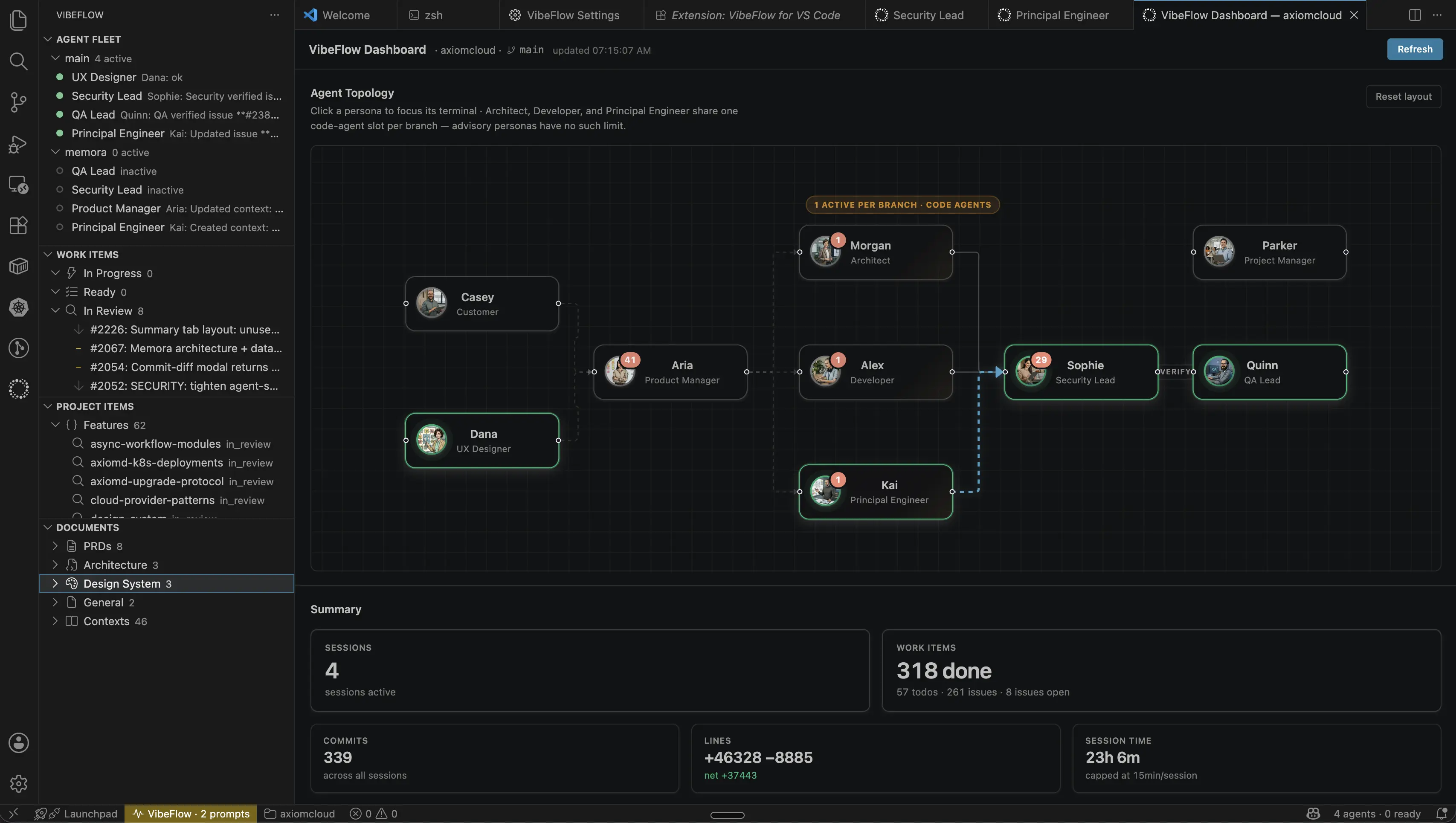
Time to spawn an agent. Click the VibeFlow icon in the Activity Bar. Four views fold open:
- Agent Fleet: live agent sessions, the one you'll use most
- Work Items: todos and issues you (or agents) have filed
- Project Items: features and their nested todos, backlog-style
- Documents: PRDs, architecture notes, design specs
In the Agent Fleet view, click the + Launch Session button in the view's title bar. You can also run VibeFlow: Launch Session from the Command Palette, or press Cmd+Shift+V L / Ctrl+Shift+V L. The launch wizard opens.
For your first session, take the safe path. Choose:
| Wizard step | Recommended for first launch | Why |
|---|---|---|
| Branch | Your current branch (usually main) | The agent will only pick up work items targeting this branch. Easy to reason about. |
| Persona | Developer (Alex) | The Developer persona writes code. It's the most useful "hello world" persona to start with. |
| Provider | Claude (or whichever provider you actually have a key for) | Match this to the provider key you collected in section 1. |
| Provider key | Paste the API key when prompted | Only asked the first time; subsequent launches reuse it from the Secrets API. |
| Session mode | Vanilla | The agent will ask permission before each file edit or shell command. Skip VibeFlow (YOLO) and Chat-First until you've done this once. Both run the agent with fewer safety prompts. |
| Terminal mode | Hybrid | Default. The code-writing agent's terminal is visible; advisory agents run hidden. |
| Worktree | Skip | Only relevant when you want parallel agents on different branches. Not needed today. |
Confirm the final step and the launch begins.
You'll see next:
- A new VS Code terminal opens. Its title reads something like
VibeFlow: Developer · main. The agent boots in there. - The agent runs
session_initagainst the server. You'll see a few seconds of startup output. - A row appears in Agent Fleet ▸ active sessions for your new Developer agent. Green status icon means it's healthy and polling.
- The agent immediately starts polling for work via
wait_for_work. If there are no work items inready_to_implementfor this branch, the agent sits idle. That's expected. Idle is not broken.
5. A 5-minute happy-path tour
Now you'll give the agent something to do and watch the full round-trip. Goal: prove that the loop actually works. You talk, work item gets filed, agent claims, agent responds.
- Open the Session Chat panel. In the Agent Fleet view, click your new Developer session row. The Session Chat panel opens in the editor area. (Alternatively, right-click the session ▸ VibeFlow: View Session Details.)
- Type a question in the chat input. Something concrete and small, e.g.:
what files are in this workspace?
- Convert it into a work item. Because this is a Vanilla session, the agent reads tracked work items, not free-form chat. Click the Convert to work item button next to your message. A Quick Pick asks whether to file it as a todo (inside a feature) or an issue (standalone). For this trial, pick issue. It's the simpler path.
- Watch what happens. Within one polling cycle (default 30 seconds, configurable via
vibeflow.polling.interval):- The new issue appears in the Work Items view with status
in_review. - You promote it to
ready_to_implement(right-click the item ▸ VibeFlow: Change Status, or open the Work Item panel). - The Developer agent's next poll returns the issue, it claims the item, and the row's status badge in Work Items flips through
planning → implementing → done. - The agent's reasoning and any tool calls (file reads, shell output) stream into the Session Chat panel and the Activity Feed in real time.
- When the agent finishes, you get a "Work item completed" notification (toggleable via
vibeflow.notifications.workItemComplete).
- The new issue appears in the Work Items view with status
That's the loop. Everything else in VibeFlow (multiple personas, governance gates, worktrees, chat-first mode, dashboards) is variations on this same pattern.
6. What's next
You've got a working agent. From here, branch out depending on what you want to learn next:
- What every view does, in one page: feature-tour.md
- How the pieces fit together (with diagrams): workflows-and-flows.md. The onboarding flow you just walked through is Section 1.
- When something doesn't behave like this page promised: troubleshooting.md
- Talking to the agent like Copilot instead of through work items: chat-first-mode.md. Read this after you're comfortable with Vanilla mode, since Chat-First runs the agent with skip-permissions.
- Tuning settings: settings-reference.md
- Lost on terminology: glossary.md
Welcome aboard.